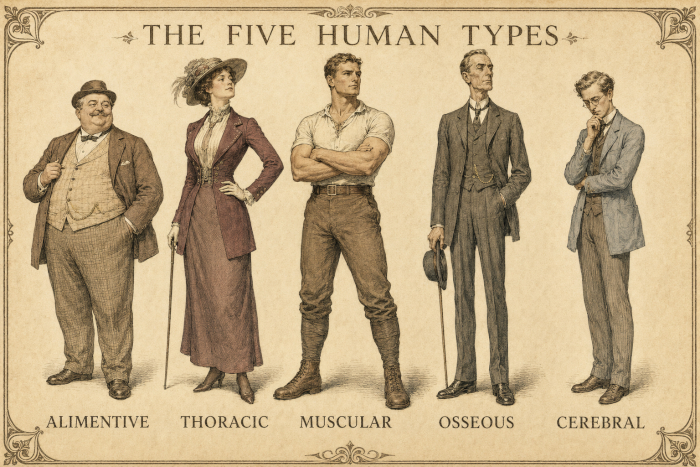
 This informal career test is based on the five personality types described in the Human Analysis system developed by Elsie Lincoln Benedict and Ralph Paine Benedict. Their 1921 book, How to Analyze People on Sight Through the Science of Human Analysis: The Five Human Types, divided people into five types: Alimentive, Thoracic, Muscular, Osseous, and Cerebral. The questions are intended to help you identify your predominant type and your secondary type.
This system assumes that certain physical features are connected with personality and career preferences. There is no good scientific evidence that body shape, facial features, or other physical characteristics can reliably reveal someone’s ideal career. For that reason, the test should be treated as an interesting self-reflection exercise rather than a professional career assessment.
Once you complete the test, a table will appear showing your scores for all five types. Your predominant type is the one with the highest score, while your secondary type is the one with the second-highest score. It is also possible to score equally for two types. This simply gives you more career ideas to consider.
Instructions: Check all the statements that apply to you.
You may also like our preference-based career test.
Section A: Alimentive
Your body has naturally rounded outlines.
You tend to carry extra weight.
You have small hands and feet.
Your head appears comparatively small in relation to your body.
You have a round face.
Your face looks youthful for your age.
You have full lips.
You love to eat and rarely forget a meal.
You don’t like to hurry.
You prefer comfortable, loose clothing.
You usually don’t take things too seriously.
You like to joke.
You are often the life of the party.
You don’t enjoy abstract theories.
You love luxury and comfort.
Section B: Thoracic
You have a flushed complexion, or your face turns red easily.
You have a kite-shaped face.
You have a high chest.
Your chest and shoulders are broad in relation to your hips.
You have a long waist.
Your nose has a high bridge and large nostrils.
You have freckles or red hair.
You are naturally graceful, even when nobody is watching.
You prefer distinctive, fashionable clothes.
You have a lot of energy.
You dislike heat and warm weather.
You have a strong temper.
You enjoy being the center of attention and may dream of becoming famous.
You adapt easily.
You look for special experiences that make you feel something strongly.
Section C: Muscular
Your body is naturally strong and solid.
You have large, firm muscles.
You have square-shaped hands.
You have a wide jaw.
Your height is below average.
You have wide, square shoulders.
You have long arms.
Your neck is thick and strong.
Your voice is loud.
Your movements are forceful and decisive.
You enjoy a physically demanding life.
You prefer practical, high-quality everyday clothes. Being fashionable isn’t particularly important to you.
You enjoy manual work or crafts.
You become restless and nervous when you have nothing to do.
You prefer taking action to sitting and thinking about what to do.
Section D: Osseous
Your bones appear proportionally large for your body.
You are tall.
You have a long face with high cheekbones.
You have a long neck.
You have prominent joints, such as ankles, wrists, elbows, or knuckles.
You almost always finish what you start.
It takes you time to make a decision.
You keep your hopes, feelings, and sorrows to yourself.
You don’t move much and tend to walk slowly.
You usually behave in a formal manner—for example, sitting upright instead of slumping.
You have good self-control.
You aren’t very spontaneous.
You are very orderly.
You don’t enjoy change or unpredictable situations. You want things to remain stable.
You don’t adapt easily.
Section E: Cerebral
You have a triangular face shape.
Your forehead is high.
Your head appears large in relation to your body.
Your body is small.
Your hands are delicate, with pointed fingers.
Overall, your body has little fat, muscle, or visible bone structure.
You don’t eat much.
You prefer mental activities to physical ones.
You like to think, contemplate, meditate, daydream, or visualize.
Money isn’t particularly important to you.
You aren’t always practical or realistic.
You don’t want to be the center of attention.
You like abstract ideas.
Your movements can be somewhat jerky.
You prefer a small circle of friends.
Your results will be displayed below.
Career Suggestions for the Five Types
The suggestions below come from the original five-type system. Use them as ideas to explore, not as rules about what you should or shouldn’t do.
Alimentive
In this system, the Alimentive type is comfortable dealing with both people and practical matters but may not enjoy working exclusively with abstract ideas. Suggested careers include sales, business, management, supervision, and work related to food, hospitality, luxury, or comfort.
Thoracic
The Thoracic type is described as energetic, expressive, magnetic, and drawn to attention. Suggested fields include advertising, art, fashion, film, television, theater, and other forms of entertainment.
Muscular
The Muscular type is said to work best with practical tasks and, in some cases, with people. Suggested fields include mechanics, technology, aviation, the automotive industry, engineering, sports, crafts, and other active occupations. This type may find entirely sedentary work less appealing.
Osseous
The Osseous type is described as independent, orderly, persistent, and most comfortable working without frequent interruption. Suggested careers include farming, fishing, agriculture, forestry, environmental work, and other occupations connected with nature or practical tasks.
Cerebral
The Cerebral type is associated with ideas, imagination, and sustained mental work. Suggested careers include writing, scientific research, programming, statistics, education, and other fields that involve analysis or abstract thinking.
Your interests, abilities, values, education, health, and opportunities are much better guides to career choice than your physical appearance. If one of these descriptions gives you a useful idea, explore it further—but don’t rule out a career simply because it belongs to a different type.
For Classrooms, Teams, and Workshops
Download once — use with unlimited participants
Shop now »