This infographic was originally published in 2014. The notes below were updated in 2026 to clarify some of the statistics and terminology.
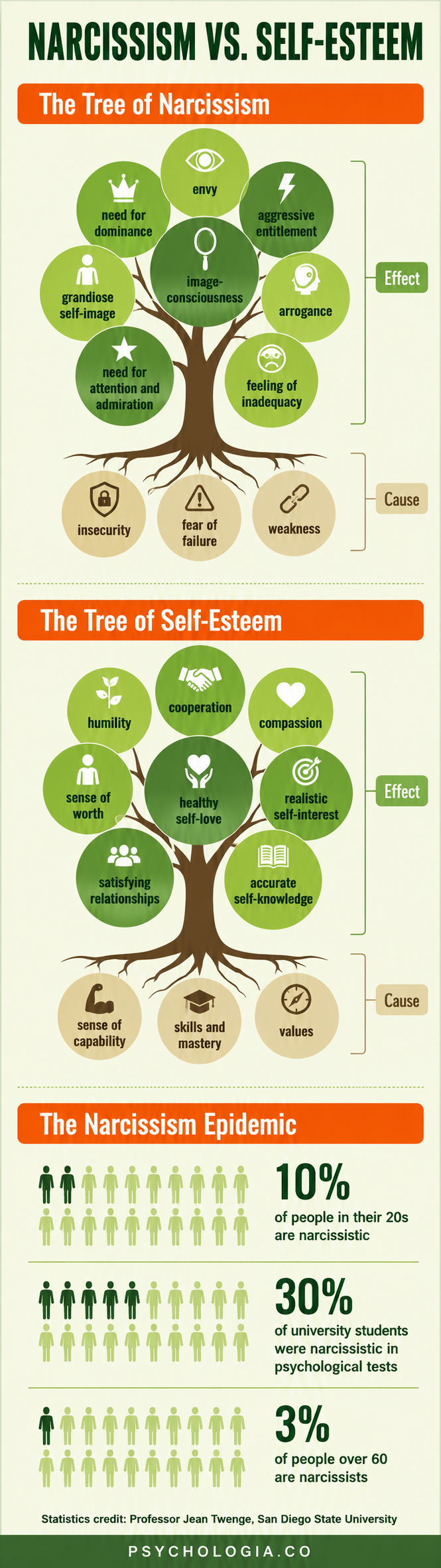
The infographic above shows narcissism and self-esteem as two different trees. It’s a simple comparison, and real people are obviously more complicated, but the basic idea is easy to see: what looks like confidence on the outside can come from very different places.
Sometimes narcissism can look like high self-esteem. A narcissistic person may seem very confident, strong, and sure of themselves. But confidence alone doesn’t tell you much about what is going on underneath. That’s the main idea behind the graphic.
The Tree of Narcissism
In the narcissism tree, the visible effects are envy, need for dominance, aggressive entitlement, grandiose self-image, image-consciousness, arrogance, feelings of inadequacy, and a need for attention and admiration.
At first, some of these may seem contradictory. How can someone feel superior and inadequate at the same time? Narcissism can include both grandiose and vulnerable features. Someone may act important, seek admiration, and still be very sensitive to criticism or anything that threatens their self-image.
The roots shown in the graphic are insecurity, fear of failure, and weakness. This was a common way of explaining narcissistic behavior when the infographic was made, but today the picture is more complicated.
2026 UPDATE: It would be too simple to say that narcissism is always low self-esteem hiding behind confidence. Research distinguishes between different aspects of narcissism. Grandiose narcissism can go together with relatively high self-esteem, while vulnerable narcissism is much more closely connected with fragile self-worth and sensitivity to criticism.
So the roots in the infographic are best seen as a simplified illustration rather than something that applies to every narcissistic person.
The Tree of Self-Esteem
The self-esteem tree shows a very different picture.
The visible effects of healthy self-esteem are humility, cooperation, compassion, a sense of worth, healthy self-love, realistic self-interest, satisfying relationships, and accurate self-knowledge.
A person with healthy self-esteem can know their own worth without needing to prove that they are better than everyone else. Confidence doesn’t have to involve putting other people down.
Healthy self-love is not the same as selfishness, and realistic self-interest is not the same as entitlement. It simply means that you recognize your own needs and value yourself while recognizing that other people have needs and value too.
The roots of healthy self-esteem shown in the infographic are a sense of capability, skills and mastery, and values. In other words, the confidence has something behind it: what you can do, what you have learned, and what matters to you.
The Narcissism Epidemic
The infographic also includes statistics about what was often called the “narcissism epidemic” at the time. These numbers were connected with research and writing by Professor Jean Twenge and other researchers.
Two different kinds of statistics appear in the graphic, and they shouldn’t be mixed together.
The figures of about 10% for people in their 20s and about 3% for people over 60 came from research on lifetime rates of narcissistic personality disorder in different age groups. They were not simply measurements of how many people in each age group seemed narcissistic.
The 30% figure needs an even more important clarification. It does not mean that 30% of university students were narcissists. A large study of American college students found that scores on the Narcissistic Personality Inventory had increased over time. The researchers described the change as a 30% increase compared with students from earlier years.
You can read the original study here: Egos Inflating Over Time: A Cross-Temporal Meta-Analysis of the Narcissistic Personality Inventory.
These are older statistics, so they are best read as part of the history behind the infographic rather than as current estimates of how many people are narcissists today.
And, of course, this doesn’t mean that every young person who is confident, ambitious, or proud of themselves is a narcissist. Confidence by itself isn’t narcissism.
The two trees are a useful shortcut for thinking about the difference. Narcissistic traits can involve grandiosity, entitlement, admiration-seeking, envy, or vulnerability. Healthy self-esteem is more compatible with realistic self-knowledge, cooperation, a sense of capability, and respect for other people.
So narcissism and self-esteem can sometimes look similar from a distance, but they are not the same thing. And what’s underneath is a little more complicated than two tidy trees can show.
Embed this in your page:
For Classrooms, Teams, and Workshops
Download once — use with unlimited participants
Shop now »